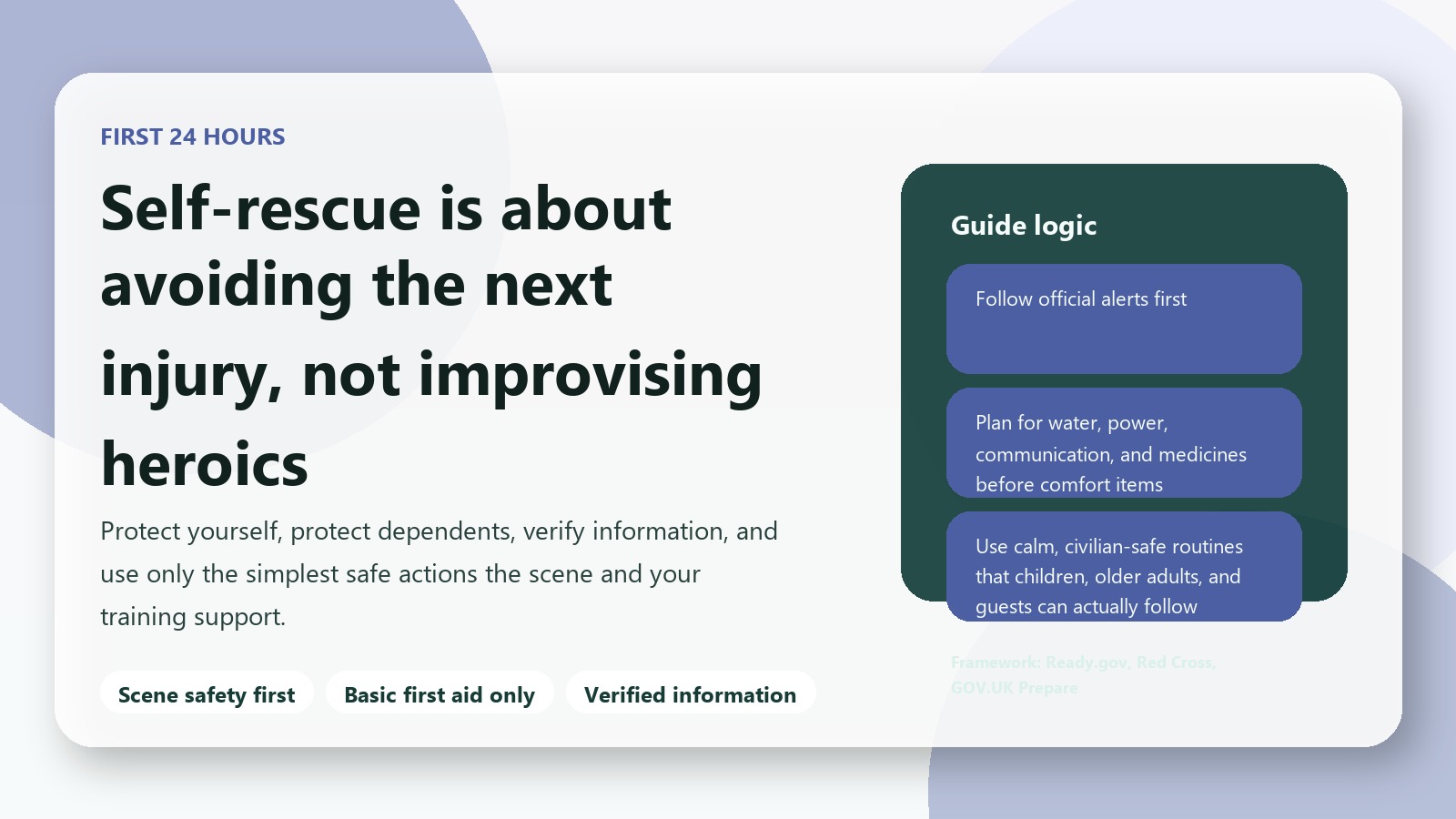
Safety boundary: This guide is about reducing avoidable risk for civilians. It does not replace emergency instructions, professional rescue, or formal first-aid training. If a scene involves fire, gas, unstable structures, or suspicious objects, distance and verified help are safer than improvisation.
First-24-hour focus
- Protect yourself from the next injury before helping others
- Reduce confusion through accountability, information discipline, and one communication lead
- Use only basic first-aid actions that are appropriate to your training and the scene
- Recognize when sheltering is safer and when the building or location itself is the hazard
The first 60 seconds: create a safer bubble
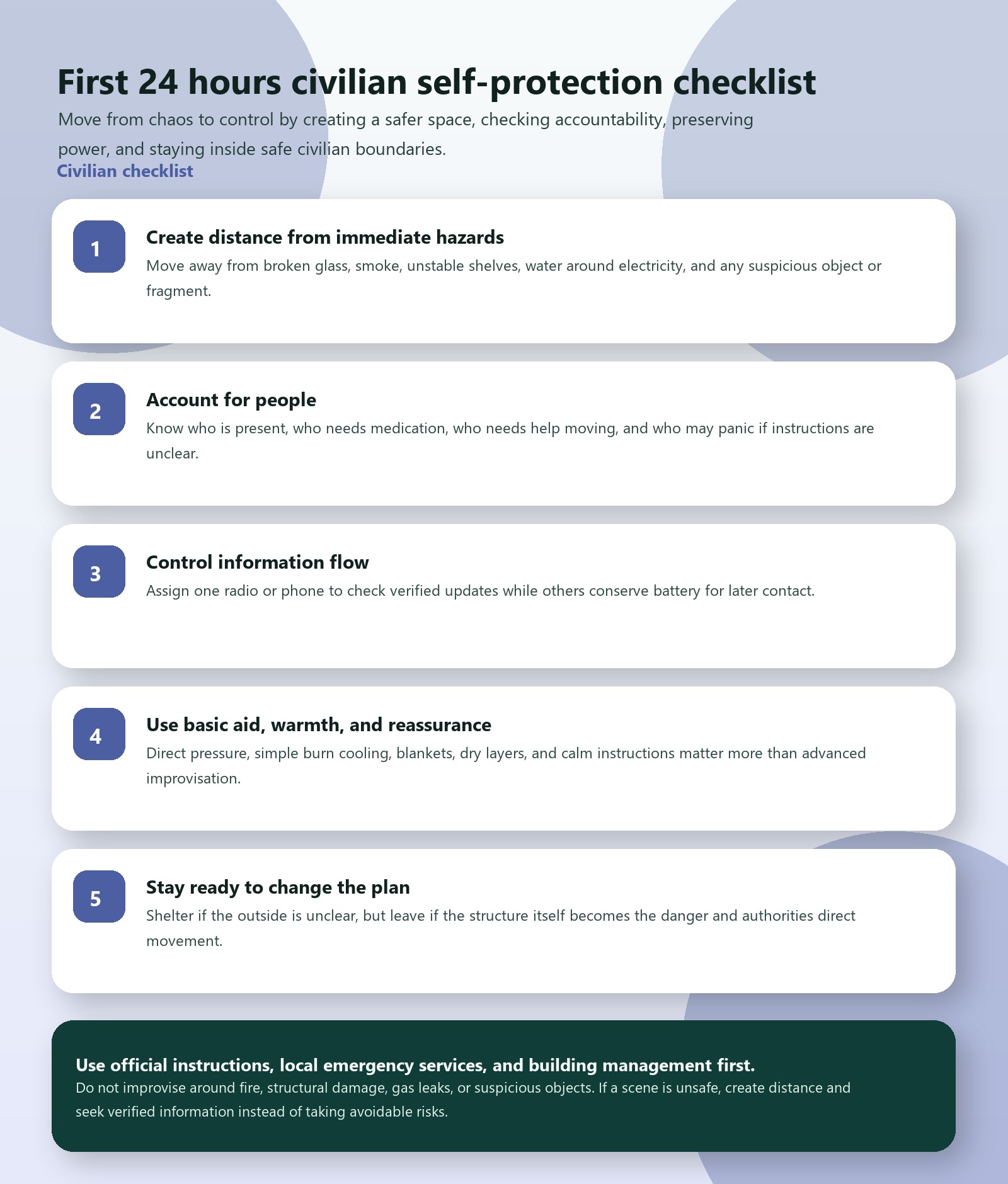
In the early moments after an explosion, violent impact, or sudden conflict-driven disruption, the scene itself may still be dangerous. Broken glass, dust, unstable shelving, damaged lighting, panic movement, and small fires often injure people after the initial event. Start by moving away from windows, putting on shoes if available, checking for obvious smoke or fire, and bringing dependents into the safest available interior space.
If the building appears compromised, fire is spreading, or gas and smoke are present, the hazard may be the structure itself. In that case, verified instructions and a safe exit route matter more than trying to collect gear. If there is no immediate building hazard, slow the room down: lights, headlamps, radio, document pouch, medicine pouch, and direct accountability for everyone in the household.
The first hour: do not let information chaos make the problem worse
- Confirm who is present: children, visitors, neighbors you are responsible for, and anyone with mobility or medical dependence.
- Assign one information lead: one phone or radio checks trusted alerts while other devices preserve battery.
- Preserve power: dim screens, label chargers, and avoid unnecessary calls if networks are congested.
- Protect the air and temperature: close interior doors if smoke is nearby, gather warmth layers if heating fails, and move away from broken windows or drafts.
- Keep exits clear: shoes, keys, bag, and document pouch should be in one visible place.
Basic first-aid actions that stay inside a civilian lane
Use the simplest effective action that matches your training and the scene. Complex improvisation often creates new harm. If emergency services are reachable, contact them early and follow their instructions.
| Problem | Safer civilian action | Important boundary |
|---|---|---|
| Visible bleeding | Apply firm direct pressure with clean dressings or cloth if you have been taught to do so | If the scene is unsafe, do not remain exposed while helping |
| Minor burns | Cool with clean running water if safe and available, remove tight items before swelling if they are not stuck | Do not break blisters or apply unsafe home remedies |
| Breathing but unresponsive | If trained, place the person in a recovery position and monitor breathing | Do not move someone with suspected spinal injury unless immediate danger requires it |
| Shock / cold stress | Keep the person warm, dry, reassured, and off the cold ground if possible | Warmth support does not replace medical evaluation when injury is serious |
| Unknown object or fragment | Mark the area mentally, keep people away, and notify authorities when possible | Do not touch, move, or collect suspicious objects |
Know when sheltering is safer than moving
If the outside environment is unclear, active instructions are still evolving, or movement would expose children, older adults, or injured people to greater risk, sheltering may be the safer temporary choice. Strengthen the room you are using with lighting, warmth, water, communication, and a clear exit path. Keep one bag ready in case conditions change.
If the immediate environment includes fire, structural instability, heavy smoke, water intrusion around electricity, or another direct building hazard, staying put may be the riskier option. In those cases, move according to official instructions and only along routes that appear safe and confirmed.
Children, older adults, and frightened people need a slower communication style
Simple, repeated instructions beat long explanations. Tell people where to sit, what to wear, which bag matters, and who is checking updates. Give children one job they can complete. Keep medicines and warmth items easy to issue without searching. Calm structure often prevents more mistakes than extra equipment.
Useful support gear already on CampEssentials
FosPower NOAA Emergency Radio
Gives the household a dedicated alert and backup charging layer when networks are congested or unreliable.
150-piece Modular Emergency First Aid Kit
Supports basic, fast-access first response without turning one pouch into clutter.
4-Pack Thermal Emergency Blankets
Useful for shock, cold rooms, roadside exposure, and waiting periods after evacuation or sheltering.
Anker 20,000mAh Power Bank
Preserves maps, phone contact, and basic information access when charging options shrink.
Final rule for self-rescue
The goal of civilian self-rescue is not to become a hero. It is to stay alive, avoid secondary injury, protect the people with you, and hand the situation over to verified instructions and professional responders as soon as that becomes possible. Distance from danger, information discipline, warmth, light, first aid, and communication make that handoff much more likely to succeed.