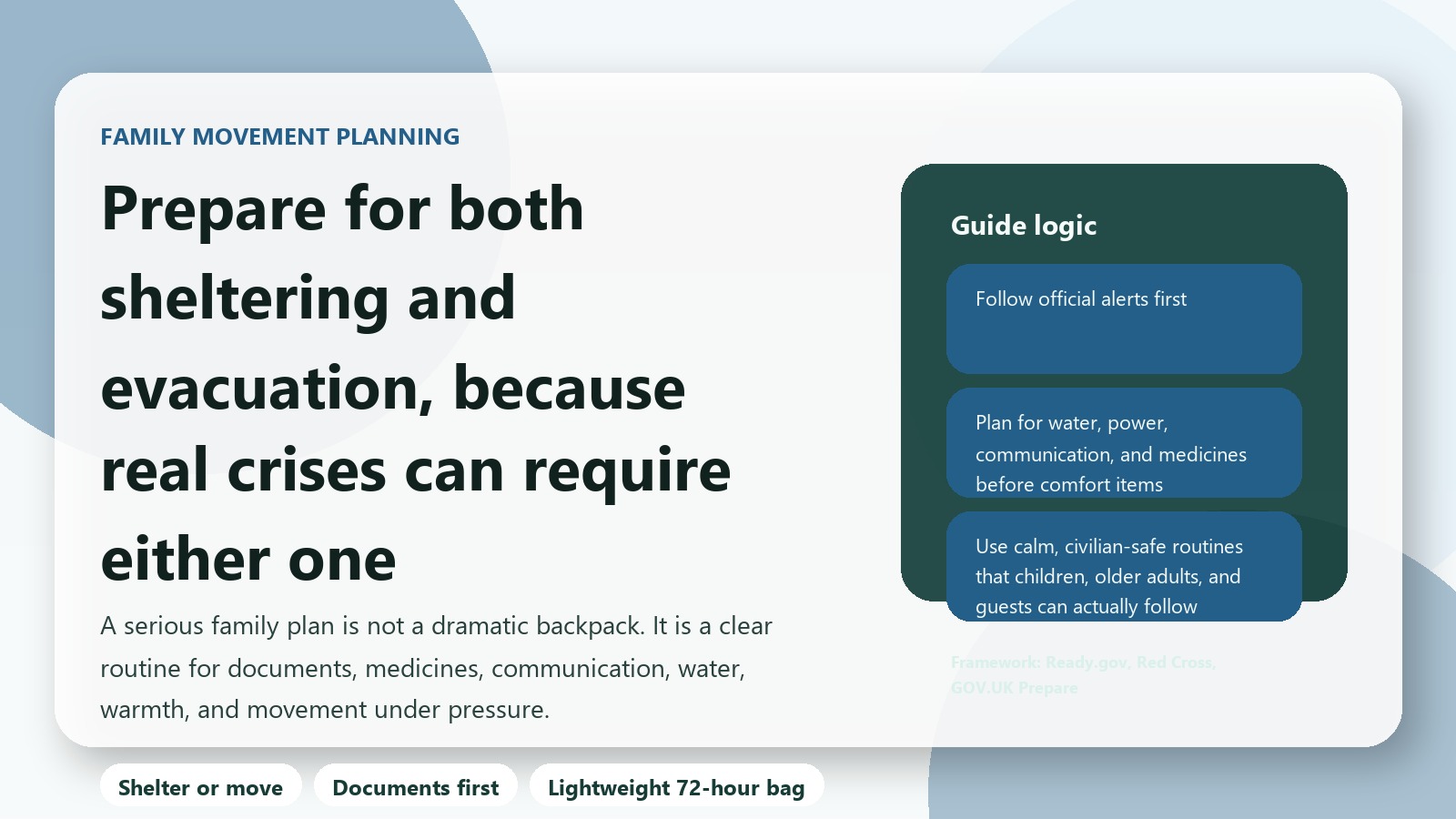
Planning standard: Public guidance is consistent on one point: households should be ready for both sheltering in place and evacuation. The safest decision is the one supported by local authorities, actual hazard conditions, and the needs of the people you are responsible for.
What this guide helps you do
- Choose between staying put and leaving with less confusion
- Stage a 72-hour bag that works for home, vehicle, or apartment evacuation
- Protect medicines, documents, communication, and the needs of children or older adults
- Buy a small number of useful support items instead of overpacking a dramatic bag
The most important decision is not the bag — it is whether to shelter or move
Ready.gov and other official emergency frameworks treat sheltering in place and evacuation as paired decisions. If authorities tell you to leave, the bag helps you move quickly and with less loss. If authorities tell you to stay, the same bag becomes a fast-access module for water, medicine, lights, documents, and clothing inside the home.
That is why the best family kit is not a single heroic backpack. It is a compact system with a clear home shelf, a movement bag, and a document pouch. The movement bag should assume you may be tired, managing other people, and loading into a vehicle or moving on foot for a short distance. That means weight discipline matters.
Use a two-part structure: a home base plus a 72-hour movement bag
| Location | Keep staged now | If you need to leave |
|---|---|---|
| Home shelf | Water, shelf-stable food, sanitation, room lighting, radio, warmth layers, prescriptions, paper contacts | Top up from the shelf into the bag if there is time and space |
| Document pouch | IDs, insurance copies, prescriptions, family contacts, spare keys, small cash, charging cables | Take this first even if you leave with almost nothing else |
| 72-hour bag | Power bank, flashlight, radio, snacks, water, thermal layer, first aid, hygiene, child or pet extras | Keep it light enough that one adult can manage it under stress |
| Vehicle module | Maps, water, blanket, chargers, visibility gear, duplicate medicine basics | Use it to extend the bag rather than turning the main bag into a heavy bin |
The first 10 minutes after an alert or sudden deterioration
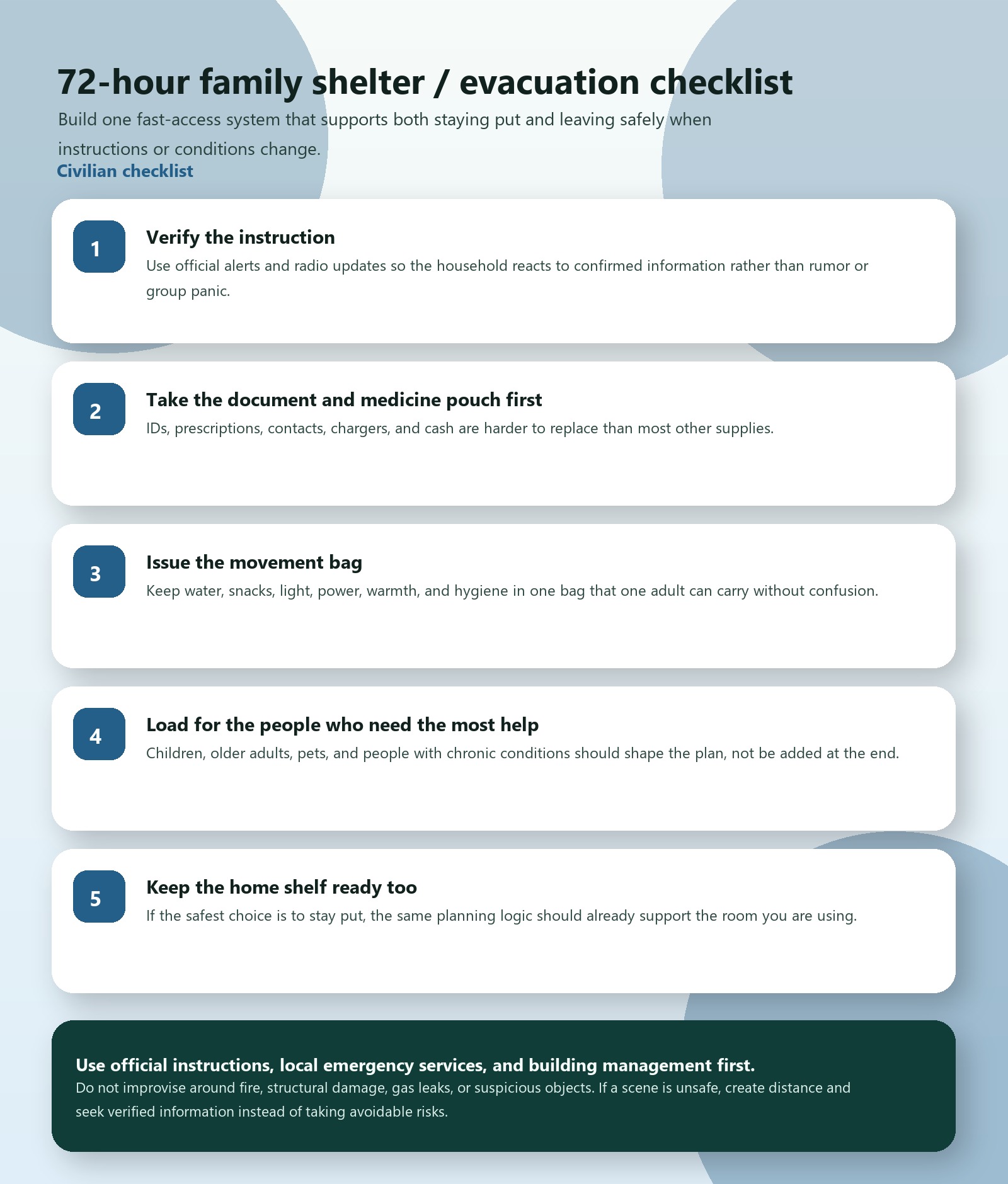
- Verify the instruction: use official alerts, radio, or trusted local channels before reacting to rumors.
- Account for people first: gather children, older adults, pets, and anyone who may need assistance moving or understanding instructions.
- Pick one lead communicator: one adult checks alerts, one manages the bag and documents, one watches dependents if possible.
- Take the document pouch and medicines immediately: these are harder to replace than most food or clothing items.
- Do a short room sweep only if time and safety allow: lights, chargers, weather layers, water, and shoes beat low-value extras.
Pack for the people who make your plan harder
A serious family plan is not built around the fastest adult in the household. It is built around the child who needs routine, the older adult who needs medication and temperature stability, the disabled household member who depends on chargers or mobility support, and the pet that cannot improvise for itself.
- Children: add comfort items, small snacks, weather-appropriate layers, and a written card with guardian contacts.
- Older adults: keep medicines, glasses, hearing aid batteries, mobility notes, and provider contacts together.
- Chronic conditions: note dosage timing, keep medical device chargers labeled, and store paper instructions with the pouch.
- Pets: stage food, water, leash or carrier needs, and any medication in a dedicated small bag.
Communication reduces panic more than most gear
One of the simplest improvements you can make is a written contact tree. Pick an out-of-area contact, note two meeting points, and keep the list in paper form. If digital tools fail, the paper card still works. Add a radio or alert device and a compact charging plan so the family can verify instructions without draining every phone at once.
Useful CampEssentials support gear for a family bag
AMORNING 276-piece Emergency Supply Kit
A useful base module when you want one organized starting point for the vehicle or front-door bag.
Anker 20,000mAh Power Bank
A simple way to protect communication and map access without jumping straight to large power systems.
4-Pack Thermal Emergency Blankets
Fast warmth support for children, older adults, roadside waits, and cold buildings.
5-gallon Storage Container
Helpful when the plan includes sheltering in place before any decision to move.
Do not turn the bag into a storage locker
A 72-hour bag should move cleanly, fit through a doorway fast, and stay understandable for another adult. If you need more volume, keep it on the home shelf or in the vehicle. The bag itself should emphasize documents, medicines, water, light, power, warmth, and basic hygiene. Comfort matters, but it comes after function.
Final rule for family planning
The best plan is the one everyone in the household can explain in one minute: where to meet, which bag goes first, who takes medicines, who checks alerts, and what triggers a move. Rehearse that logic long before you need it.