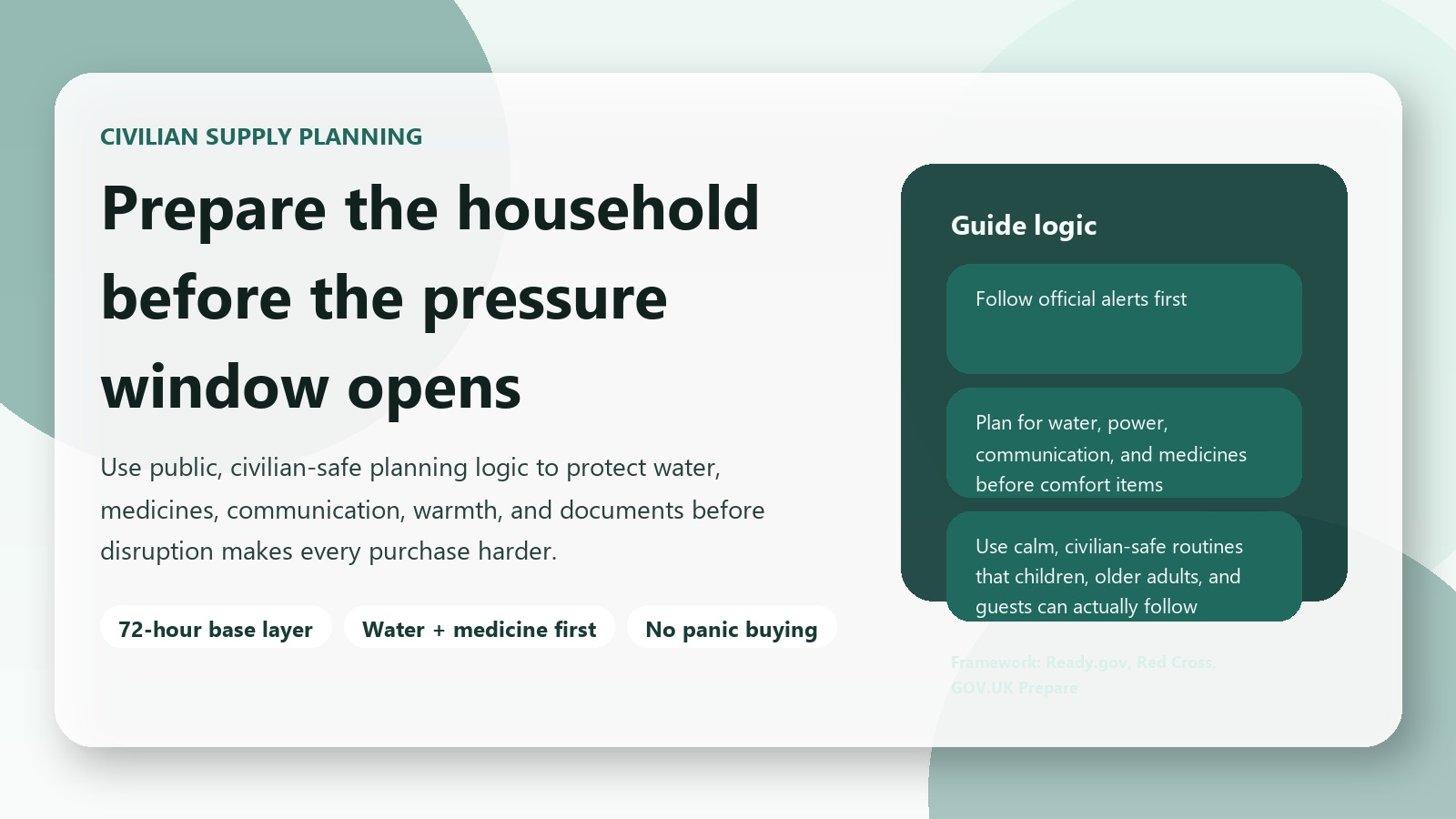
Reference framework: This guide adapts public planning principles from Ready.gov’s kit, shelter, and evacuation guidance, the Red Cross family planning model, and the UK government’s Prepare campaign. It is written for civilian continuity and safe household preparation, not tactical action.
What this guide covers
- How to set civilian priorities before shortages or movement restrictions begin
- Which supplies matter most for water, medicine, communication, warmth, and sanitation
- How to buy and store in layers without panic buying or wasting money
- Which current CampEssentials products can support the plan without overbuilding it
Start with a civilian order of priority
When people hear the word war, many jump straight to dramatic ideas: escape bags, hard gear, or scenarios that are unlikely to match their real life. Public preparedness guidance is more grounded than that. The first job is to protect the systems that most homes lose first: clean water confidence, medicine access, communications, backup light, safe warmth, and documents that make relocation or assistance easier.
That means your first purchases should support continuity instead of spectacle. If your home cannot cover a few days of drinking water, charge phones and radios reliably, locate medicines in seconds, or manage warmth in an unheated room, the gap is not advanced equipment. The gap is basic infrastructure inside your own household.
Build a three-layer supply plan
A strong civilian shelf usually grows in three layers. Layer one covers the first 72 hours, because that is where confusion and delay create the fastest pressure. Layer two extends into a fuller household buffer, which matters when resupply, movement, or utility restoration takes longer than expected. Layer three is what you add only after the basics are stable: redundancy, comfort, and better organization.
| System | Start here first | Upgrade only after the base layer is in place |
|---|---|---|
| Water | Stored drinking water, one dependable filter, cups, labeling, refill routine | Additional containers, gravity filtration, backup treatment tablets, cleaner rotation storage |
| Food | Shelf-stable items the household already tolerates, manual opener, simple utensils | Longer-duration food buckets, improved cooking support, rotation notes by person |
| Medicines | Current prescriptions, dosage list, copies of key medical records | Longer buffer if legal and available, spares for glasses, batteries for medical devices |
| Communication | Phone charging cables, power bank, radio, written contact list | A second radio, vehicle charging plan, household check-in schedule, low-signal backup devices |
| Light and power | Headlamps, flashlights, spare batteries, labeled charging pouch | Portable power station, folding solar support, low-draw room lighting plan |
| Warmth and hygiene | Blankets, warm layers, gloves, soap, wipes, toilet basics | Thermal blankets, room zoning plan, compact wash setup, duplicates for vehicle or office |
| Documents and money | IDs, insurance copies, emergency contacts, small cash reserve | Organized waterproof copies, relocation pouch, spare chargers, translated copies if relevant |
Keep procurement calm and staged
One of the safest lessons from official preparedness campaigns is that preparation should begin before the hardest news cycle, not after it. That does not mean buying everything immediately. It means staging purchases in an order that preserves household function.
- Buy now: drinking-water storage, first-line medicines, backup lighting, phone charging, radio access, and a written contact list.
- Buy next: filtration, sanitation supplies, compact warmth layers, longer-duration food, and a second communication or charging layer.
- Buy later: better organization, cleaner storage, backup duplicates for vehicle or office kits, and comfort upgrades that make longer sheltering more manageable.
Storage discipline is what makes the shelf real
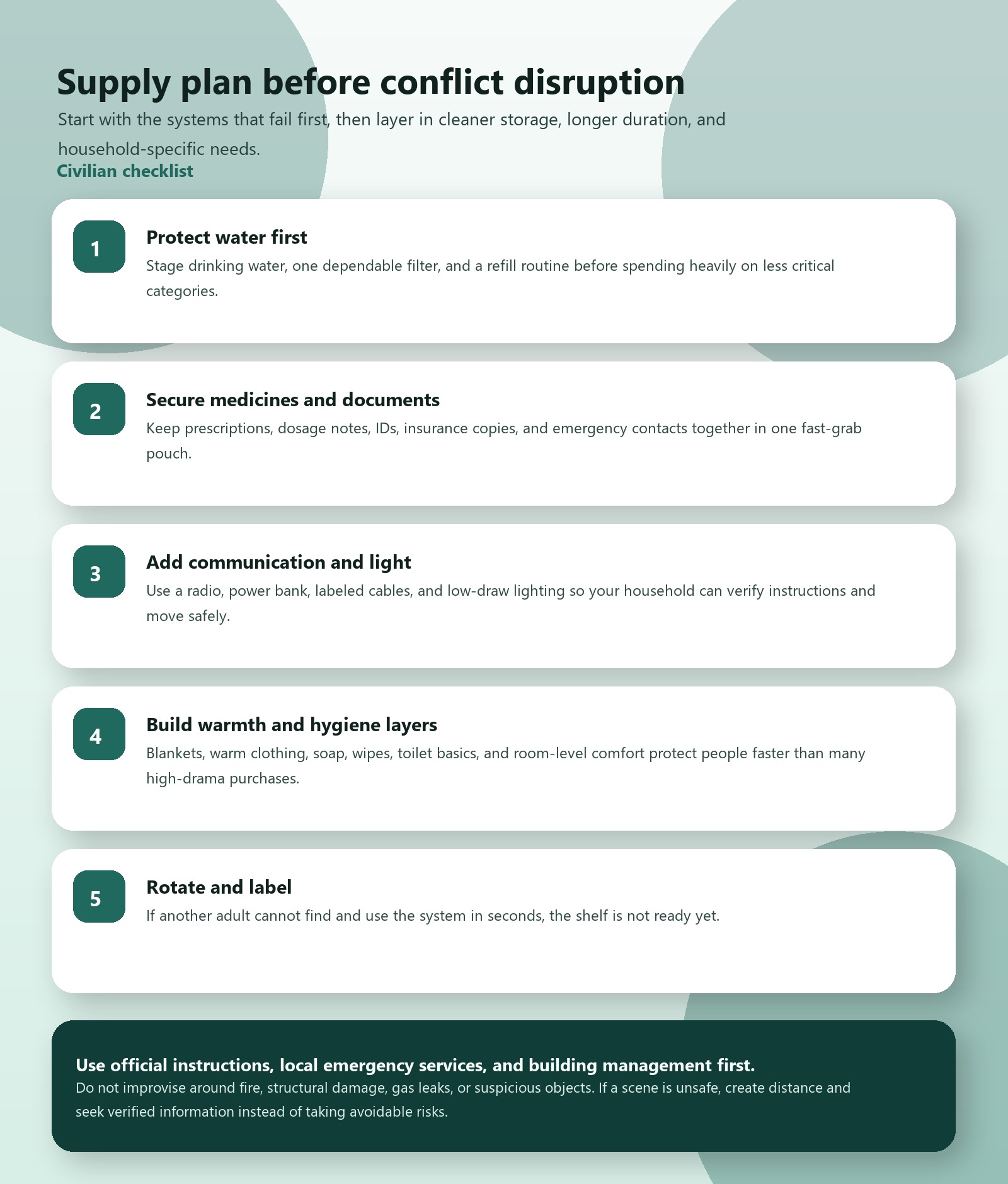
Preparedness fails when supplies scatter into too many rooms, expire without notice, or cannot be found by another adult in the home. Store water modules together, keep medical items clearly labeled, and separate core documents from daily clutter. If you have children, older adults, or a household member who may need help from a neighbor or relative, label the high-value items so someone else can step in quickly.
A simple rotation calendar is better than a perfect spreadsheet nobody uses. Check food dates, water rotation, batteries, prescription refill timing, and key contact information at predictable intervals. If a system is not easy to check, it is not ready.
Procurement should match realistic household roles
A ground-floor family apartment, a suburban home with garage storage, a commuter who depends on a small vehicle, and a caregiver supporting an older relative will not buy the same things in the same order. Official guidance repeatedly points to planning by household role and location. That is why it helps to keep one home shelf, one smaller vehicle module, and one document-and-communication pouch that can move fast if needed.
It also helps to think in jobs rather than objects. Do you have a clean way to hold drinking water? A way to verify alerts if cell service is weak? A way to see and move safely in the dark? A warm layer that can be issued quickly to a child or older adult? Those are better questions than simply counting gadgets.
Useful support gear already on CampEssentials
This site should not replace your planning process, but a few products can support the exact base-layer jobs described above.
32-cup 5-Stage Water Filter Dispenser
A daily-use filtration layer that helps households build confidence before an emergency starts.
5-gallon Storage Container
Useful for cleaner household water rotation and more organized shelter-in-place reserves.
FosPower NOAA Emergency Radio
A compact alert and charging backup that supports information discipline when phones and power are uncertain.
150-piece Modular Emergency First Aid Kit
Keeps basic first response and labeled organization easier for families and vehicle kits.
Common mistakes that make a household look prepared but stay fragile
- Buying too much food before water, medicine, and communication basics are covered
- Keeping supplies in multiple random containers instead of one clear staging system
- Assuming a phone alone is a communication plan even when power or network quality may drop
- Ignoring children, older adults, disability needs, or pet requirements until the last minute
- Treating comfort items as if they can substitute for reliable lighting, warmth, hygiene, and clean water
Final planning rule
If a household can cover water, medicines, communication, light, warmth, and documents with low confusion, it has already solved a large share of what makes the early phase of conflict-driven disruption dangerous. Start there, keep it organized, and let every later purchase reinforce the same logic.